Salvatore Michele Carnazzo; Desirèe Balconara; Salvatore Scirè Calabrisotto; Andrea Domenico Praticò – This study aimed to synthesize the current literature on cranial POCUS in neonates and infants and propose a structured clinical protocol.
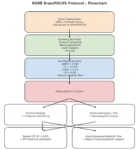
Salvatore Michele Carnazzo; Desirèe Balconara; Salvatore Scirè Calabrisotto; Andrea Domenico Praticò – This study aimed to synthesize the current literature on cranial POCUS in neonates and infants and propose a structured clinical protocol.
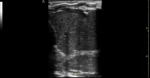
Alyssa DaVolio; Brandon S. Hays; Matthew O. Thompson; Michael J. Walsh; Parvesh M. Garg; Ricardo J. Rodriguez – This case demonstrates the utility of lung POCUS as an initial diagnostic tool in the neonatal intensive care unit (NICU) for CDH.
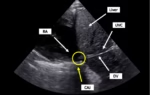
Jacob Kelner; Douglas Moote – This case reports a UVC in malposition in the liver viewed on POCUS after appearing to be in the correct position on both anteroposterior (AP) and lateral X-rays.

David J McCreary; Rashed Chowdhury; Cameron Hamilton – This study retrospectively applied a POCUS CDR to patients presenting to a paediatric emergency department (PED) with atraumatic limp over a 5 year period.

Karunya Jayasimha; Wei Liu; William Hanna – This study correlates IJV POCUS with CVP in mechanically ventilated post-operative children following congenital heart disease surgery.

Yair Katzir; Yehuda Tzur – This study describes, for the first time, the use of pediatric emergency physician-performed CEUS in the evaluation of minor abdominal trauma in a child.

David J. McCreary; Maria Munir; Milan Gopal – This study presents the first reported case of a Canal of Nuck hydrocoele identified using POCUS in a child. This case highlights the role of POCUS as a safe, reliable, first-line imaging tool for identifying Canal of Nuck hydrocoeles in patients with VP shunts

Isabelle Munyangaju; Lucia Carratala-Castro; Sozinho Acacio; José Miguel Escudero Fernández; Antoni Soriano-Arandes; Maria Espiau; Begoña Santiago Garcia; Alicia Hernanz-Lobo; Ángel M. Lancharro Zapata; Aleix Soler-Garcia; Enrique Ladera; Antoni Noguera-Julian; Angela Manzanares; Daniel Blazquez; Elisa Aguirre Pascual; José Massingue; Jessica Dalsuco; Justina Bramugy; Isabelle Thierry-Chefque Bassat; Danilo Buonsenso; Elisa Lopez-Varela; Xavier Serres-Créixams – This study shows that Mediastinal POCUS, guided by a standardized protocol, represents a safe, affordable, point-of-care, and non-ionizing option for identifying mediastinal lymphadenopathy. Its application holds promise for improving the diagnosis of paediatric tuberculosis, especially in settings with limited access to advanced radiological imaging.

Stephanie K. Leung; Ria Dancel; Riya N. Soni; Ariadna Perez-Sanchez; Michael J. Mader; Haitham Al-Wahab; Thomas W. Conlon; Maria V. Fraga; Javier J. Lasa; Andrea Matho; Hannah Smith; Nilam J. Soni – The primary objective of this study was to compare the image quality, ease of use, and overall satisfaction of six handhelds available in the United States when used by pediatric POCUS experts. Additionally, we sought to identify the most and least important characteristics of common handhelds per pediatric POCUS experts.

Michelle S. Lee; Fatima Mir; Amerta Ladhani; Huba Atiq; Shaun K. Morris; Mark O. Tessaro – This study aimed to 1. Deliver a train-the-trainer program in Pakistan on lung POCUS for diagnosing pediatric pneumonia; 2. Determine inter-rater reliability between i) study-trained community health workers (CHWs) and a remote expert, with both interpreting POCUS examinations acquired by the CHWs, and ii) study-trained CHWs and local champions, with both interpreting examinations that they had acquired.